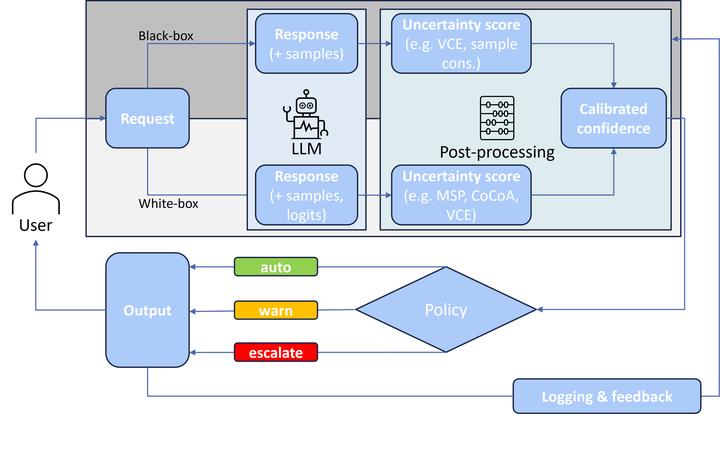
 Deployment pipeline including LLM Uncertainty Evaluation
Abstract
Large language models (LLMs) produce outputs with varying levels of uncertainty, and, just as often, varying levels of correctness; making their practical reliability far from guaranteed. To quantify this uncertainty, we systematically evaluate four approaches for confidence estimation in LLM outputs: VCE, MSP, Sample Consistency, and CoCoA (Vashurin et al., 2025). For the evaluation of the approaches, we conduct experiments on four question-answering tasks using a state-of-the-art open-source LLM. Our results show that each uncertainty metric captures a different facet of model confidence and that the hybrid CoCoA approach yields the best reliability overall, improving both calibration and discrimination of correct answers. We discuss the trade-offs of each method and provide recommendations for selecting uncertainty measures in LLM applications.
1. Introduction
LLMs are powerful but not reliably calibrated: high confidence does not always mean high correctness. For safety-critical or user-facing systems, we need well-calibrated confidence so downstream components (or users) can decide when to trust, defer, or verify a model’s output. This project systematically compares four uncertainty methods and reports what works best in practice.
2. Methods
2.1 Evaluated Approaches
- VCE (Variance of Confidence Estimates): Variability of confidence across perturbations/prompts.
- MSP (Maximum Softmax Probability): Uses the model’s top probability as a proxy for confidence.
- Sample Consistency: Measures agreement across sampled generations (e.g., different temperatures/seeds).
- CoCoA (Consensus-Consistency Aggregation): Hybrid method combining agreement signals and confidence scores (Vashurin et al., 2025).
2.2 Tasks and Model
- Tasks: Four question-answering benchmarks.
- Model: A state-of-the-art open-source LLM evaluated under a unified pipeline (same prompts, decoding settings, and scoring).
2.3 Metrics
- Calibration (e.g., ECE / reliability curves): How well predicted confidence matches empirical accuracy.
- Discrimination (e.g., AUROC for correctness detection): How well a score separates correct vs. incorrect answers.
3. Results
3.1 High-Level Findings
- Each method captures a distinct uncertainty signal:
- MSP is simple and strong but can be over-confident.
- VCE surfaces instability under prompt or sampling changes.
- Sample Consistency reflects agreement across generations.
- CoCoA outperforms others overall, improving both:
- Calibration (confidence aligns better with true accuracy),
- Discrimination (clearer separation of correct vs. incorrect answers).
3.2 Practical Trade-offs
- Cost vs. Accuracy: Methods requiring multiple samples (VCE, Sample Consistency, CoCoA) are more compute-intensive but yield better reliability.
- Simplicity vs. Robustness: MSP is trivial to deploy; CoCoA is more robust but requires orchestration of multiple signals.
4. Recommendations
- If you need a drop-in baseline: Start with MSP; monitor miscalibration and add temperature scaling if possible.
- If you can afford moderate overhead: Add Sample Consistency to catch brittle answers.
- For best reliability: Use CoCoA to combine agreement-based and score-based signals; prioritize it for user-facing or safety-critical deployments.
- Always visualize calibration (reliability plots) and track a correctness AUROC to ensure your uncertainty signal is meaningful.
5. Conclusion
Reliable LLM systems hinge on trustworthy confidence estimates. Our experiments show that while single-signal methods (MSP, VCE, Sample Consistency) provide useful but partial views, the hybrid CoCoA approach achieves the best overall reliability by combining signals. Teams should select a method that matches their latency/compute budget and risk profile, with CoCoA as the preferred option when reliability matters most.
Reference: Vashurin, R., Goloburda, M., Ilina, A., Rubashevskii, A., Nakov, P., Shelmanov, A., & Panov, M. (2025). Uncertainty Quantification for LLMs through Minimum Bayes Risk: Bridging Confidence and Consistency. arXiv preprint arXiv:2502.04964.

Christian Hobelsberger
Statistics Student at LMU Munich | Data Science at Munich Re
Statistics student at LMU Munich with a penchant for data science and chess!